
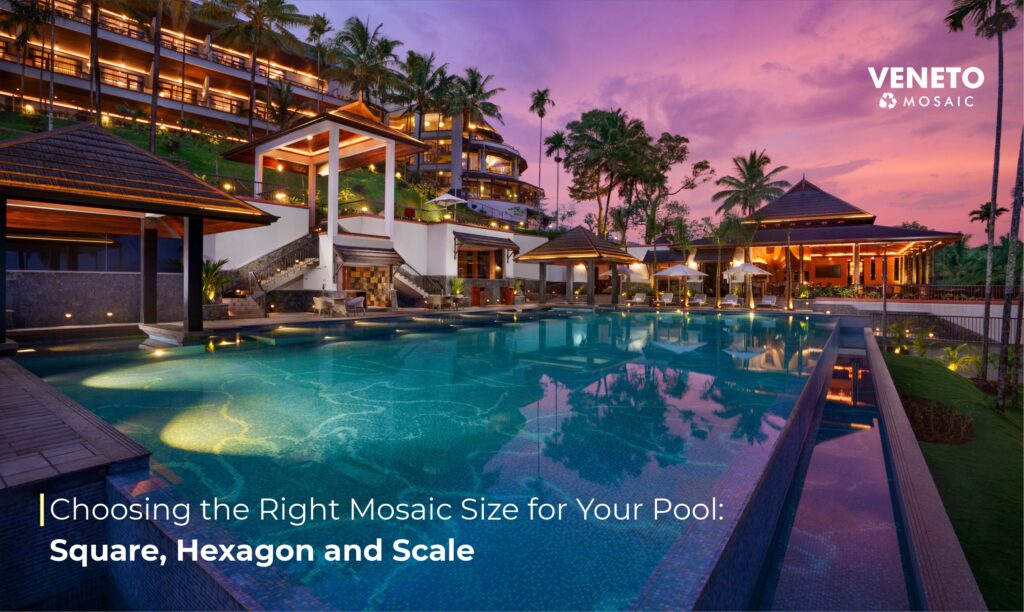
A pool mosaic decision usually starts with colour. It should end with size. The tile that looks perfect on a sample board can behave completely differently once it’s used on a curved step, a vanishing edge, or forty square metres of open water. Size is the quiet engineer behind every pool finish; it decides how much grout you see, how tight a curve can bend, and how the whole surface holds together once the water goes in.
This guide breaks down the two main formats used in swimming pool mosaic tiles, square and hexagon, across the sizes that matter most: 2.5×2.5cm, 5x5cm, 2.5cm hexa and 5cm hexa. If you’re specifying a pool right now, this is the practical, install-level detail that colour boards don’t cover.
Size Decides What the Water Can Do
Every pool has geometry problems to solve. Steps, coves, waterline curves, spa jets, drain fittings- each one asks the tile to bend, wrap or terminate cleanly. Smaller pool mosaic tiles solve this easily. Larger tiles resist it.
That’s the trade-off at the centre of this whole decision. Smaller format tiles follow curves with far less cutting, which keeps the finish tight and reduces visible seams around fittings. Larger-format tiles require more cuts on anything other than a straight wall or floor, and those cuts show.
So before colour, before collection, ask what shape the pool actually is. A rectangular lap pool with straight walls has very different needs from a freeform pool with rounded steps and a curved spa edge.
Square Tiles Hold Their Line
Square pool mosaic tiles, in 2.5×2.5cm and 5x5cm, are the standard for a reason. As a Veneto recycled glass mosaic, it installs fast, aligns cleanly on straight runs, and gives installers a predictable grid to work from.
The 2.5×2.5cm square is the finer of the two. More individual pieces per square metre means more grout lines, and more grout lines mean a softer, more textured overall look from a distance. It also means the tile can wrap gentle curves reasonably well, since each piece is small enough to nudge into a slight arc without visible strain.
The 5x5cm square scales up. Fewer pieces, fewer grout lines, and a bolder, more graphic finish. On a large open pool floor, this size reads as calmer and more unified; the colour block reads as one surface rather than a field of small dots. The trade-off is flexibility. A 5x5cm glass mosaic pool tile resists curves harder than its smaller sibling, and any pool with tight radii will need more cutting to make it work.
Hexagons Bend Where Squares Resist
Hexagon pool mosaic tiles change the geometry entirely. Instead of a grid, you get a honeycomb, and that shape has a natural advantage on freeform surfaces. Because a hexagon has six edges instead of four, it can follow a curve with a gentler stepped effect than a square ever could, even at the same nominal size.
The 2.5cm hexa is the most forgiving option for tight curves, rounded steps and organic pool shapes. It’s the size specifiers reach for when a pool has been designed without straight lines in mind.
Veneto’s 5cm hexa keeps the honeycomb pattern but with more visual weight per piece. It suits pools that want the softness of a hexagon shape without the density of the smaller format, a middle ground between geometric precision and an organic feel.
Hexagon layouts also do something square grids can’t: they break up sightlines. On a pool mosaic floor viewed from above, a hexagon pattern moves the eye in more directions, which can make a smaller pool feel less boxed in.
Scale Changes on Approach
A sample chip tells you almost nothing about how a mosaic floor tile will actually look once it’s underwater and stretched across forty or fifty square metres. Scale changes everything.
Small-format pool mosaic tiles, the 2.5cm sizes, tend to blend into a single field of colour when viewed from a distance, like the pool deck or a balcony above. Step closer, and the individual pieces and grout lines become visible, adding texture and a handmade quality up close.
Large format tiles do the opposite. From a distance, individual pieces are more visible, giving the floor a more graphic, patterned character. Up close, the surface feels bolder and less intricate.
Neither is better. It depends on how the pool will actually be experienced; a rooftop pool viewed mostly from above needs a different answer than a resort pool where guests spend most of their time standing in the shallow end looking down.
Smaller Tiles Cost More Than They Look
Size affects budget in ways that aren’t obvious from a price-per-square-metre sheet. Smaller swimming pool mosaic tiles mean more individual pieces to lay, more grout lines to fill, and more installation hours on site. Larger pool mosaic tiles install faster and use less grout, which can offset a higher per-piece cost.
Curved surfaces flip this equation. A pool with heavy curves and a large-format tile will burn through material in cuts and offcuts, pushing waste up and eroding any labour savings. In those cases, a smaller size, square or hexa, often ends up more efficient overall, even with more grout lines to manage.
This is also where sizing intersects with sustainability. As a recycled glass mosaic, Veneto keeps the material at the centre of the decision; getting the size right for the pool’s actual geometry keeps offcut waste to a minimum, which matters for a material built on circular use in the first place. Choosing the correct scale isn’t just a design decision. It’s part of using the material responsibly.
Match the Size to the Job, Not the Trend
There’s no single correct size for pool mosaic tiles. The right answer depends on the pool’s shape, how it will be viewed, the installation timeline, and the budget available for labour versus materials.
A straight-edged lap pool with a tight schedule favours 5x5cm squares. A freeform resort pool with curved steps favours 2.5cm hexa. A rooftop pool viewed mostly from above can lean into either scale for its floor tile, depending on how bold the client wants the finish to feel.
Veneto’s Plain, Blend, Gradation, Decoration and Mural items are available across these size and format combinations, which means the size decision doesn’t have to compromise the colour or effect a project has already committed to. Size and surface effects work together, not against each other, once the pool’s geometry is clearly mapped out.
Related read: For more on how surface effect shapes the final look, see our guide to Veneto’s seven pool mosaic collections.
FAQs
1. What size pool mosaic tile is best for a pool with curves?
Smaller formats work best on curves. 2.5cm hexa is the most forgiving for tight radii and freeform steps, followed by 2.5 x 2.5 cm square. Larger tiles resist curves and need more cutting.
2. Is 5x5cm or 2.5×2.5cm better for a pool floor?
It depends on the pool’s shape and how it will be viewed. 5x5cm installs faster with fewer grout lines and suits straight-edged pools. 2.5×2.5cm gives a finer, more textured finish and handles gentle curves better.
3. Do hexagon mosaics cost more than square mosaics?
Not inherently. Cost depends more on tile size and pool geometry than on shape alone. Hexagons can actually reduce waste on curved surfaces compared to square tiles of the same size.
4. Can I mix tile sizes in one pool?
Yes. Many projects use a larger format on flat floor areas and a smaller size or hexa shape around steps, coves, and waterline details where curves are tighter.
5. Does mosaic size affect how long installation takes?
Yes. Smaller tiles have more individual pieces and grout lines, which generally means longer installation time. Larger tiles install faster on straight surfaces but slower on curved ones due to extra cutting.