
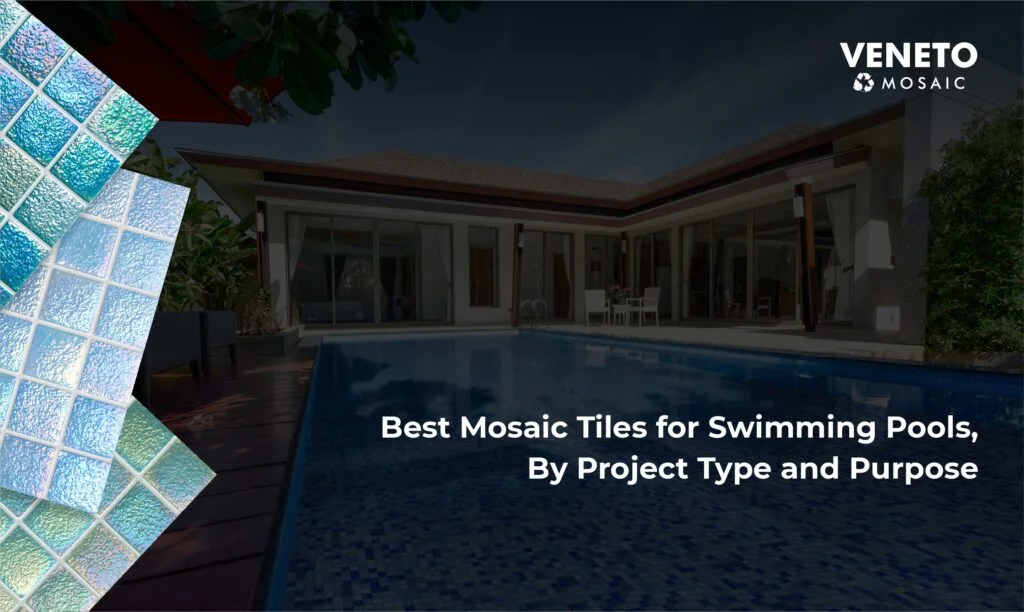
Ask ten designers what makes the best mosaic tiles for swimming pools, and you’ll get ten different answers, because they’re often picturing ten different pools. A backyard pool for a family of four has different priorities than a resort pool meant to anchor a hotel’s brand. A civic pool funded by public money answers to a different set of expectations than a rooftop pool squeezed onto a tight urban footprint. Increasingly, recycled glass mosaics are showing up as the answer across more than one of these contexts, though for different reasons each time.
So instead of chasing one universal answer, it helps to start with a more useful question: what kind of pool is this, and what does the project need the tile to do for it? Increasingly, that second part includes something beyond looks and grip. It includes what the material says about the project itself.
The right glass mosaic tile depends on the project, not just the pool
Tile selection usually gets treated as a technical decision. Size, finish, colour, and installation method. All of that matters, and we’ve written a full breakdown of size, colour, and installation for pool mosaics here. But before any of those choices make sense, it helps to know what the pool is actually for.
A backyard pool serves a household. A resort pool serves a brand experience. A public pool serves a community and, often, a compliance checklist. Each of these contexts pulls the decision in a different direction, and increasingly, one factor runs through almost all of them: sustainability is no longer a soft add-on. It shows up in briefs, in certifications, and in how a project chooses to position itself to the people who’ll use it.
Residential backyard pools: practical first
For a homeowner, the brief is usually simple. The glass mosaic tile needs to hold up to regular use, stay within budget, and not demand constant upkeep. Families want something that looks good for years without turning maintenance into a chore.
This is where smaller, well-understood considerations carry the most weight: how the glass mosaic tile handles steps, how it cleans, how it ages. If you want the full picture on tile size, colour behaviour, and installation for pools, you’ll find it here, so here it’s enough to say that residential pools reward practical choices over statement-making ones. That said, more homeowners are also asking where their glass mosaic tile comes from because sustainable choices increasingly feel like the responsible default rather than a luxury add-on.
Hospitality and resort pools: where the glass mosaic tile becomes part of the brand
A resort pool isn’t just a place to swim. It’s a photograph, a centerpiece, often the single image a guest associates with the entire stay. Here, durability under heavy daily traffic matters as much as visual impact, since a resort pool gets used by hundreds of people a week, every week, for years.
Finish plays a real role here too, both visually and underfoot. We’ve compared matt and gloss finishes for pools in detail here, including how each one performs around steps, sun exposure, and waterline maintenance, which is worth a read before finalising a resort-scale order.
This is also where sustainability starts to do real work for the project and for the planet. Guests notice when a property can speak credibly about its materials. Hotel brands increasingly build sustainability into their own positioning, and a pool finished in recycled glass mosaic gives that story something tangible to point to, more than a line in a brochure. Sustainability today enhances how a project presents itself, and a pool, being one of the most visible and photographed parts of any resort, is a natural place for that story to live.
Public, civic, and large-scale developments: sustainability as a requirement
For public pools, civic developments, and large international projects, the calculation shifts again. Here, sustainability often isn’t a nice-to-have; it’s written into the brief. Certifications, procurement standards, and public accountability all push toward materials that can demonstrate a genuine reduction in environmental impact, not just a marketing claim.
This is exactly the space where recycled glass mosaics earn their place. Veneto’s approach starts with discarded glass and turns it into a high-quality mosaic surface, built on the circular use of materials rather than virgin raw inputs. For a large-scale or publicly funded project, that’s not a soft selling point. It’s a material decision that can support the sustainability targets the project is already required to meet.
Rooftop and urban pools: working within real constraints
Rooftop and urban pools respond to a different set of pressures entirely. Weight matters because structural load limits what a building can support. Exposure matters, since rooftop pools often face more direct sun and wind than ground-level installations.
And space matters, since these pools tend to be smaller and need every design decision to earn its place.
These constraints narrow the field of suitable materials before sustainability even enters the conversation. But for urban developments aiming for green building credentials, a rooftop pool finished in recycled glass mosaic can quietly support that goal alongside meeting the practical demands of the space.
What "recycled glass mosaic" actually means
It’s worth being specific about what this material is, since the term gets used loosely. Veneto’s mosaics start as glass that would otherwise become waste. That glass gets processed, refined, and reformed into a glass mosaic tile, rather than being manufactured from virgin raw material from the start.
This is the circular use of materials in practice: something the world already produces too much of, given a second purpose instead of being discarded. It’s not a finishing touch applied after the fact. It’s built into how the material exists in the first place. For a closer look at how recycled glass mosaics differ from regular glass mosaics in practice, this comparison covers it in detail.
Recycled origin, full performance
The understandable question that follows is whether a material made from waste can really hold up in a demanding environment like a pool. It can. Pools and spas put real stress on any surface, with constant water exposure, chemical treatment, and temperature shifts. A glass mosaic tile’s origin story doesn’t excuse it from that test.
Despite coming from recycled material, Veneto’s mosaics are built to deliver the durability these environments demand. The performance bar doesn’t move because the source material changed. That’s the point. A sustainable choice shouldn’t require a trade-off, and in this case, it doesn’t. For more on how recycled and regular glass mosaics compare on durability and installation systems, this breakdown is worth reading.
Sustainability as project value
Here’s where the two threads of this guide come together. Choosing the best mosaic tiles for swimming pools isn’t only about what holds up underwater. For many projects today, it’s also about what the choice supports beyond the pool itself.
A developer pitching to investors can point to material sourcing as part of a broader sustainability story. A hospitality brand can use it to back up the green claims guests now expect to see backed by something real. A public project can use it to help meet certification or procurement standards that increasingly favour circular materials over virgin ones.
This is what it means to compete on purpose and performance together. The material doesn’t ask anyone to choose between doing the responsible thing and getting a pool that lasts. Both come from the same decision.
Matching the glass mosaic tile to the project
Pulled together, the pattern looks like this. Residential pools reward practical, low-maintenance choices, with sustainability as a welcome bonus rather than the main driver. Hospitality and resort pools benefit from recycled glass mosaic tile that supports both visual impact and brand storytelling, where sustainability adds real weight to the guest experience. Large-scale and public projects often need sustainability as a baseline requirement. Rooftop and urban pools work within tighter physical constraints, where a material like recycled glass mosaic can meet practical needs while still supporting broader green goals.
Across all four, Veneto’s range gives projects a way to make that decision without compromising on what the pool needs to do day to day.
Sustainable doesn't mean a trade-off
The best mosaic tiles for swimming pools aren’t decided by a single ranking. They’re decided by what the pool needs to do, who it serves, and increasingly, what story the project wants to tell about itself. Recycled glass mosaics give projects of every scale a way to meet that need without giving up on performance. The waste becomes the surface, and the surface still holds up to everything a pool demands of it.
FAQs
1. Are recycled glass mosaics as durable as standard pool tiles?
Yes. When manufactured to proper standards, recycled glass mosaics match standard tile in strength and water resistance, with the added benefit of a smaller environmental footprint.
2. Does choosing recycled glass mosaics help with green building certifications?
It can. Many certification frameworks credit projects for circular material use, so recycled glass mosaic can support those targets, though specific requirements vary by certification body.
3. Is sustainable pool tile more expensive than standard options?
Processing recycled glass can carry a higher upfront cost, but the long-term value often balances out through durability and reduced maintenance, particularly in demanding environments.
4. Do hospitality and resort projects really need sustainable materials, or is it optional?
It’s increasingly expected rather than optional. Guests and brands alike now treat material sourcing as part of the overall experience and reputation of a property.
5. What makes a pool tile suitable for large-scale or public pool projects specifically?
Consistency across large batches, proven durability under heavy use, and the ability to support sustainability or certification requirements all matter more at this scale than in a single residential pool.